Uncover the Hidden Traits of Your Introverted Nature
Explore Yourself
Introvert Personality Quiz: Am I an Introvert or an Extrovert?
 Understanding Introvert Personality Types: Traits and Balanced Energy
New Updates

Introvert Vs Extrovert Quiz: the Complete Guide to Understanding Social Energy
What These Assessments Measure and Why They Matter
Many people want a clear, friendly way to understand how they recharge, focus, and connect with ot...

Introvert–Extrovert Tests: A Complete Guide to Understanding Your Social Energy
Understanding the Spectrum and Why It Matters
The idea of introversion and extroversion describes where you naturally direct attention, how you recha...

The Complete Guide to Understanding Introverts, Extroverts, and Ambiverts
The Modern Spectrum of Sociability and Energy
Personality preferences around social energy are not rigid boxes, and they operate more like a spectrum...
Find Out if You Are Introvert or Extrovert
Get StartedThe Ultimate Introvert Quiz: Unlock Your Inner Self
You have likely felt the tug-of-war between craving connection and craving quiet, and that tension reveals more than a simple preference for company or solitude. Social energy fluctuates with tasks, environments, and the pace of a day, while cognitive preferences shape how we pay attention, reflect, and decide. Rather than a rigid box, think of personality as a dynamic system: behavior shifts with stress, novelty, stakes, and values. Because of that dynamism, people benefit from seeing patterns over time, not snapshots, and from designing routines that honor both stimulation and recovery. Cultural scripts complicate things as well, praising constant visibility in some settings and silent rigor in others, which can distort how we interpret our own needs and strengths.
Labels can still serve as useful shorthand when they prompt thoughtful experiments with boundaries, scheduling, and communication. Within this lens, the introvert extrovert meaning becomes clearer as a spectrum rather than a binary reality, opening the door to personalized ways of working and relating. By zooming out from stereotypes and zooming into lived rhythms, you can align energy with intention and make room for sustainable momentum. That alignment allows for social nourishment without cognitive overload, and for solitude without isolation, creating a resilient baseline for both performance and wellbeing.
- Social energy rises with novelty, urgency, and reward signals, then drops after intensive exchange.
- Cognitive bandwidth depends on task complexity, interruptions, and the fit between goals and values.
- Recovery is not optional: micro-breaks, transitions, and sleep consolidate memory and restore focus.
- Context matters: a noisy café might fuel some tasks yet sabotage others, even for the same person.
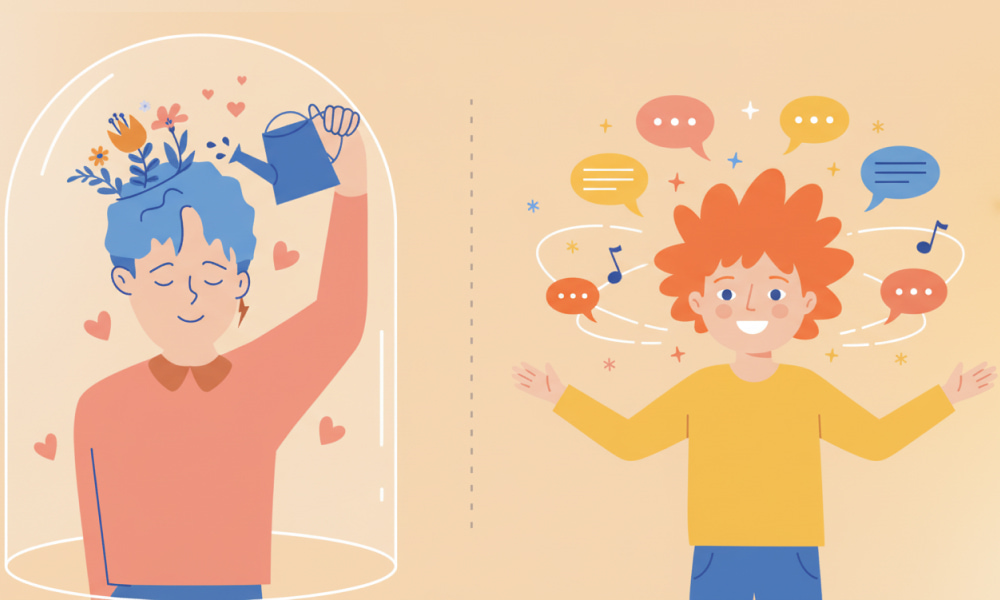
Core Differences Across Contexts: Communication, Focus, and Recovery
When people ask why one colleague prefers long-form memos and another thrives in rapid stand-ups, they are really asking about social energy economics. Communication style, sensory sensitivity, and preferred decision cadence often explain divergent work methods. One person might listen deeply and respond after synthesis, while another verbalizes thoughts early to explore options. Neither approach is inherently superior; each solves different problems under different constraints. The most productive teams normalize both contemplative and conversational routes to clarity, so meetings, docs, and async channels each carry their load.
Researchers frame the difference between introvert and extrovert through arousal thresholds, which guide situational comfort. In high-input environments, some people reach saturation quickly, while others feel most alive when information flows fast. Because both tendencies can create blind spots, pairing complementary styles helps a group notice risks, surface insights, and iterate decisions with fewer errors. Calibrating the balance of stimulation to recovery is not indulgence; it is operational hygiene that keeps performance steady under pressure. Practitioners map introvert personality types onto behavioral clusters to support coaching programs, offering language that prompts skill-building rather than excuses. You can translate that language into practical agreements: meeting formats that rotate facilitation, documentation that captures dissent, and norms that protect deep work hours. Over time, those agreements evolve from etiquette to infrastructure, reducing friction for everyone while lifting collective throughput.
- Communication: blend structured agendas with open-floor dialogue to serve multiple processing speeds.
- Focus: reserve silent blocks for complex tasks, and schedule interactive bursts for alignment and planning.
- Recovery: institutionalize breaks, flexible seating, and predictable schedules to stabilize energy.
Thriving at Work: Designing Roles, Routines, and Environments
High-performing organizations treat attention like a precious resource, and they engineer workflows that respect it. Role design matters: customer-facing sprints, research cycles, and creative incubation each tax people differently. Rotations, buddy systems, and quiet rooms help reduce cognitive residue, while explicit norms about messaging hours lower alert fatigue. Even small environmental tweaks, adjustable lighting, plant walls, or noise zoning, can transform how quickly teams hit flow and how long they can sustain it. In team rituals, the phrase introvert extrovert often oversimplifies collaboration, so managers should tune processes. Stand-ups can become written check-ins twice a week, while design critiques alternate between live discussion and annotated boards. Hiring should value multiple forms of presence: presenting in a webinar, writing a crisp brief, facilitating a retrospective, or running a structured user interview. When diverse styles contribute to shared goals, momentum compounds and morale stabilizes.
- Set meeting budgets with clear purposes, owners, and artifacts to curb performative busyness.
- Adopt decision frameworks that separate exploration from commitment to reduce unproductive debate.
- Use energy-aware calendars that cluster similar tasks to minimize context-switching costs.
Relationships and Social Life: Connection Without Burnout
Outside of work, friendships and family routines deserve the same thoughtful design. Social calendars often fill by inertia rather than intention, so it helps to ask what types of gatherings truly restore you. Some people love long dinners with a few close friends, while others thrive at community events buzzing with movement. In either case, clarity about personal limits prevents resentment and keeps connections warm. Rituals, weekly walks, hobby nights, or shared volunteering, anchor belonging without draining reserves.
In social circles, the question what is extroverted introvert arises when a person enjoys people yet needs deliberate recovery time. The answer points to situational flexibility rather than contradiction, since traits show up differently across environments and roles. Clear communication helps partners and friends plan: decide in advance how long you will stay, where you will sit, and what exit signals mean, so needs get met without friction or guesswork.
Some psychologists explore the 4 types of introverts as mental frameworks, which can be helpful but never definitive. Labels can guide discussion about sensitivity to stimulation, social appetite, inner speech, and risk tolerance. What matters most is testing assumptions with gentle experiments: alternate between hosting and attending, try smaller venues before larger ones, and blend high-energy weekends with quiet resets so joy increases while fatigue decreases.
- Create “bookend” routines before and after gatherings to manage stimulation and support recovery.
- Negotiate plans with time-boxed commitments and a backup option to reduce social pressure.
- Track how you feel during, immediately after, and the next day to calibrate future choices.
The Benefits of Each Style: Strengths That Power Life and Work
Every style offers distinct advantages, and communities flourish when those advantages are recognized and woven together. Quiet concentration unlocks meticulous analysis, imaginative synthesis, and patient iteration, while high sociability unlocks rapid alignment, creative cross-pollination, and energizing momentum. When leaders distribute responsibilities to match these strengths, outcomes improve and people feel seen. That alignment also reduces conflict, because differences become complementary resources rather than points of friction.
Among common queries, the phrase is introvert a personality gets tossed around in workplace debates, and the short answer is nuanced. Trait research points to relatively stable preferences with flexible expression, which means people can stretch without pretending to be someone else. Respect for those preferences fuels psychological safety, and safety fuels candor, curiosity, and better decisions across the board.
For leaders, comparing the introvert vs extrovert dynamic can unlock complementary strengths across projects and timelines. Strategic planning might benefit from slower, reflective loops, while launch phases might benefit from outward-facing energy and rapid coordination. Teams that name and leverage these differences build trust faster, preserve energy longer, and deliver results with fewer last-minute scrambles.
- Deep work: extended focus produces accuracy, insight, and creative breakthroughs.
- Social drive: fast feedback accelerates learning and reduces costly misalignment.
- Partnership: pairing styles diversifies problem-solving and buffers fatigue.
Common Myths, Busted: Stereotypes vs Reality
Popular culture often confuses shyness with sensitivity to stimulation, or equates charisma with competence. Those conflations obscure what is actually happening under the hood: people regulate input to protect focus and well-being, and they express warmth in different formats. Someone can be socially skilled and still prefer quiet recovery, just as someone else can love buzz yet savor solo time for craft. Mature self-knowledge rejects one-size-fits-all scripts and prioritizes conditions that allow character to show up consistently.

Between perceived poles sits the label introvert extrovert ambivert, which many people wear while contexts shift across the week. Rather than a final destination, think of that label as an invitation to observe patterns and build flexible routines. When situations change, new team, new city, new season, adjustments are expected, not evidence of inconsistency. That perspective keeps identity stable while behavior adapts wisely.
- Myth: Quiet equals unfriendly; Reality: warmth can be conveyed through attentive presence and follow-up.
- Myth: Talkative equals superficial; Reality: quick rapport can coexist with depth and loyalty.
- Myth: Balance means 50/50; Reality: balance means the right dose for the current context.
Tools and Assessments: Make Insight Practical
Before redesigning your calendar or office setup, establish a baseline and choose a small set of habits to trial. Data from journals, device usage, and meeting analytics can help, but qualitative notes matter most: how did the day feel, and what enabled progress. Try experiments in two-week sprints, then keep what clearly helps and discard what drains you. Over time, a personal playbook emerges, guiding when to seek buzz and when to shield focus.
Before changing habits, a reflective introvert extrovert test can anchor your baseline, though no tool replaces self-observation. For deeper insight, a targeted introvert test can reveal preference patterns, yet results should be integrated with journaling. To compare tendencies, a calibrated introvert vs extrovert test offers a snapshot, providing language that informs experiments. Pair any instrument with notes on sleep, nutrition, and stress, since physiology often masquerades as personality and skews perceptions. The quick matrix below summarizes practical tools you can deploy right away and how each one supports energy alignment in daily life.
| Tool | Primary Benefit | Best Use Case |
|---|---|---|
| Energy Journal | Tracks peaks, dips, and triggers to reveal patterns | Optimizing calendar blocks and meeting timing |
| Social Debrief | Captures after-event insights to refine plans | Planning gatherings without overload |
| Strengths Map | Aligns tasks with natural advantages | Delegation and role design on teams |
| Recovery Plan | Builds rituals that stabilize attention | Preventing burnout during heavy cycles |
| Collaboration Canvas | Defines communication norms and artifacts | Reducing friction across functions |
- Start with one change at a time to isolate what drives the improvement.
- Use weekly retrospectives to adjust, keeping what works and pruning the rest.
- Share preferences with teammates to set mutual expectations early.
Find Out if You Are Introvert or Extrovert
Get StartedFAQ: Straight Answers to Common Questions
-
How do I know whether I’m more energized by solitude or by social interaction?
A simple way is to time your reflection: notice how you feel before, during, and after different activities, then track the consistency of those responses. If you wonder about labels, the line am I an introvert captures a binary instinct, but look for energy patterns over labels to guide better decisions. When your calendar aligns with those patterns, you experience steadier motivation and less friction throughout the week.
-
Are online quizzes useful for self-discovery or just entertainment?
Many short instruments provide a spark for conversation, not a final diagnosis, and their quality varies widely. In casual settings, an online introvert extrovert quiz may feel playful, yet treat outcomes as conversation starters rather than verdicts. The most reliable insights emerge when you pair any quiz with observation, feedback, and small lifestyle experiments.
-
What if I relate to both quiet focus and lively gatherings?
People often express different sides depending on role, stress, and stakes, so it is normal to feel pulled in both directions. For a clearer snapshot, a guided am I introvert or extrovert quiz can be useful, provided you validate the items against lived experience and recent context. Over time, you will likely discover predictable triggers and reliable recovery practices that honor both needs.
-
Can personality-informed habits improve teamwork and reduce conflict?
Absolutely, because shared language and clear agreements reduce guessing and prevent avoidable tension. When teams normalize multiple ways of contributing, they capture more ideas while protecting attention and energy. Rituals that combine written input with live collaboration also give quieter voices room to shape decisions meaningfully.
-
What’s the best first step to redesign my week around sustainable energy?
Begin with a two-week audit that tags activities by intensity, importance, and recovery cost, then cluster similar tasks. After the audit, adjust meeting density, sleep windows, and break placement, and add one low-effort recovery ritual. Small improvements compound quickly, especially when you review results and refine the plan each Friday.